
Thailand Overview
Thailand sits at the heart of mainland Southeast Asia, connecting ASEAN markets to the global economy. With international airports, deep-sea ports, and expanding rail and highway networks, the country supports trade, tourism, manufacturing, and regional logistics at scale. Bangkok anchors finance and national policy, while growth corridors such as the Eastern Economic Corridor accelerate industrial upgrading, innovation, and high-value investment. Beyond business, Thailand offers cultural depth shaped by history, Buddhist traditions, and community values, alongside a lifestyle that ranges from world-class cities to beaches and mountain retreats. A welcoming environment, competitive costs, reliable infrastructure, quality healthcare, and strong public services reinforce its appeal for relocation, investment, and long-term living.
Geography & Landscape
Located in the heart of mainland Southeast Asia, Thailand shares borders with Myanmar, Laos, Cambodia, and Malaysia. The country covers approximately 513,000 square kilometers and is geographically diverse:
Northern Thailand features mountainous terrain and cooler climates, with cities such as Chiang Mai serving as cultural and creative hubs.
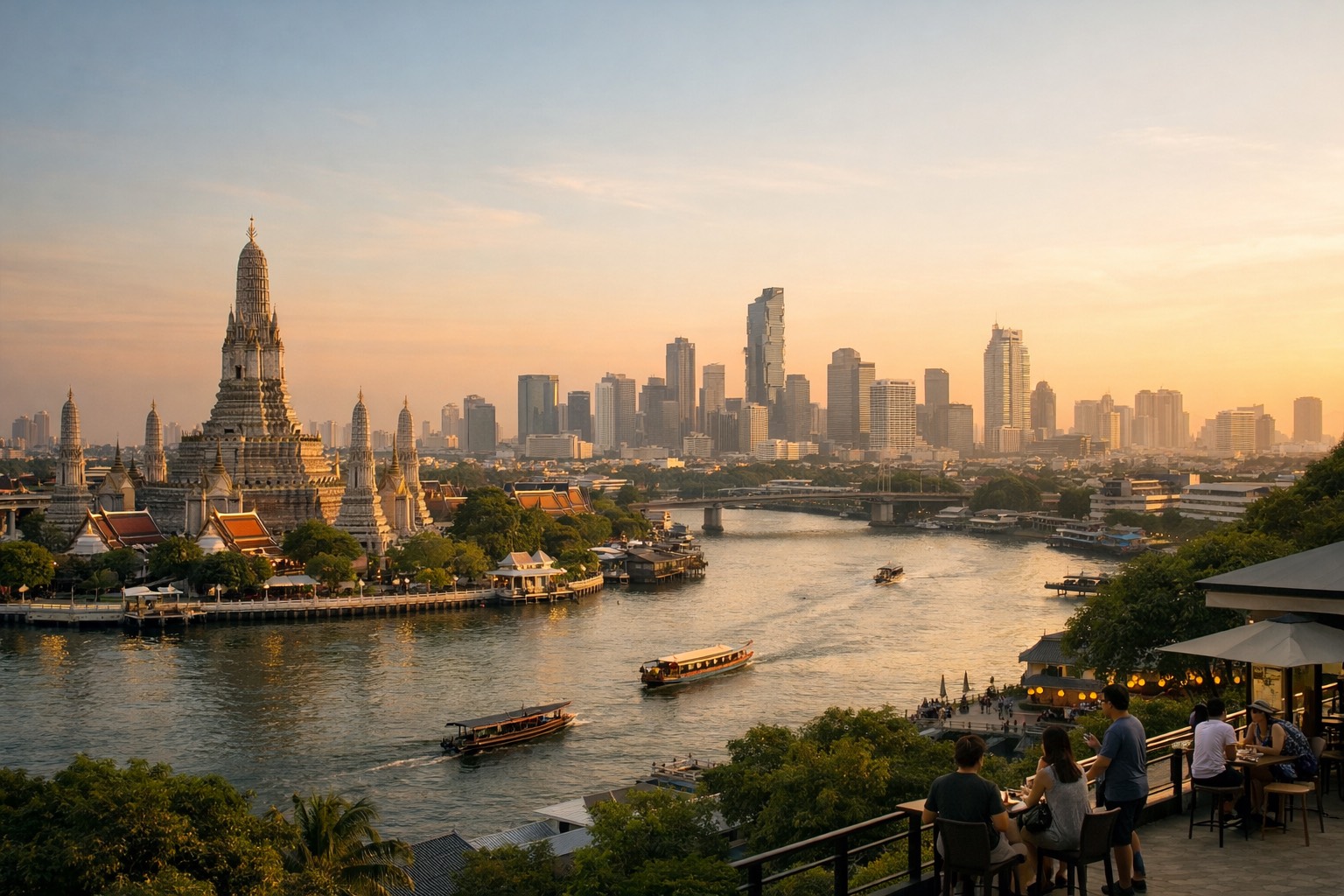
Central Thailand is home to fertile river basins and the capital city, Bangkok, the nation’s political and economic center.
Eastern Thailand includes industrial corridors and coastal provinces connected to the Eastern Economic Corridor (EEC).
Southern Thailand is defined by tropical coastlines along both the Andaman Sea and the Gulf of Thailand, including globally recognized destinations such as Phuket.
This geographic diversity supports agriculture, tourism, industry, logistics, and maritime trade.
Population & Demographics
Thailand’s population reflects a diverse and evolving demographic landscape shaped by regional distribution, urbanization, and economic transformation. With more than 70 million residents, the country maintains a balanced mix of metropolitan concentration and rural communities. The central region, particularly around Bangkok, represents the largest population cluster and serves as the primary economic and administrative hub. Northern, northeastern, and southern provinces retain distinct cultural identities, languages, and settlement patterns that reflect historical development and geographic diversity. Thailand is also experiencing gradual demographic aging, influencing labor markets, healthcare systems, pension planning, and long-term social policy direction. Alongside the ethnic Thai majority, longstanding Chinese-Thai communities and other regional groups contribute to social diversity. Growing expatriate populations, foreign professionals, digital entrepreneurs, and international retirees further shape Thailand’s demographic structure, particularly in key business corridors, industrial zones, and coastal tourism centers.
Economy & Key Industries
Thailand has one of Southeast Asia’s most diversified economies. Core sectors include:
Manufacturing (automotive, electronics, food processing)
Tourism & hospitality
Agriculture & food exports
Logistics & regional trade
Real estate & infrastructure development
Healthcare & medical tourism
Bangkok functions as the primary financial and commercial hub, while industrial clusters in the Eastern region support export-driven growth. Thailand’s strategic location enables access to ASEAN’s combined market of over 600 million people.
Major commercial activity is concentrated in and around Bangkok, while industrial estates across the country support foreign direct investment. Thailand’s balanced economic structure offers both stability and long-term growth potential for regional and global stakeholders.
Language & Communication
Language in Thailand reflects both national unity and strong regional identity. Central Thai is the official language used in government, media, and education, forming the linguistic foundation of public life. However, distinct regional dialects remain widely spoken: Northern Thai in the north, Isan in the northeast, and Southern Thai in the south. These dialects shape local expression, humor, and social nuance, reinforcing community identity across provinces. In major urban centers such as Bangkok, English is commonly used in business, tourism, and international institutions. Communication styles tend to be polite and context-sensitive, emphasizing respect, tone, and non-verbal cues. Understanding both standard Thai and regional variations enhances cultural awareness, strengthens relationships, and supports effective long-term engagement.
Climate & Seasons
Thailand has a tropical climate divided into three distinct seasons, each influencing lifestyle, travel, and business activity throughout the year:
1) Hot Season (March–May)
High temperatures and dry conditions affect most regions, particularly central and inland areas. Daytime heat can be intense, shaping working hours and outdoor routines.
2) Rainy Season (June–October)
Influenced by the southwest monsoon, this period brings regular rainfall and higher humidity. Showers are often brief but may impact travel and infrastructure planning, especially in major cities.
3) Cool Season (November–February)
Generally the most comfortable period, with milder temperatures and lower humidity. Northern provinces experience cooler mornings, while coastal areas remain warm and suitable for tourism and outdoor activities.
Thai Traditions & Cultural Heritage
Thailand’s cultural heritage is deeply rooted in centuries of history, spirituality, and regional identity. Traditions are shaped by Buddhism, the monarchy, and enduring community values that emphasize respect, gratitude, and social harmony. Architectural landmarks such as Wat Phra Kaew reflect refined craftsmanship and religious devotion, while historic temples across the country preserve artistic symbolism and sacred narratives that illustrate Thailand’s spiritual depth. Important national festivals, including Songkran and Loy Krathong, symbolize renewal, purification, and gratitude toward nature and community bonds. Classical dance, traditional music, mural art, and silk weaving continue to express cultural refinement, while rural communities safeguard regional customs, local wisdom, and ceremonial rituals, sustaining Thailand’s cultural continuity amid modernization and global change.
Political System & Governance
Thailand operates under a constitutional monarchy, where the King serves as Head of State and the government is administered through a parliamentary system. The Prime Minister leads the executive branch, supported by the Council of Ministers, while legislative authority is exercised through a bicameral National Assembly.
Over the past decades, Thailand has continued to refine its legal and regulatory frameworks to support economic development, foreign investment, and administrative modernization. Independent courts and regulatory bodies play key roles in upholding rule of law, commercial certainty, and institutional stability—factors that remain important for investors and international residents.
Global Positioning
Strategically positioned at the center of ASEAN, Thailand serves as a regional hub for trade, logistics, tourism, and cross-border investment. As a founding member of ASEAN and an active participant in multilateral trade agreements, the country benefits from strong regional integration and global connectivity.
Thailand maintains diversified economic partnerships across Asia, Europe, the United States, and the Middle East. Its infrastructure, supply chain networks, and industrial base make it a competitive platform for companies seeking access to Southeast Asia’s fast-growing consumer markets and manufacturing ecosystems.
A Nation of Opportunity
Thailand’s strength lies in its combination of geographic advantage, economic diversity, cultural heritage, and lifestyle appeal. It is both a gateway to Southeast Asia and a destination in its own right — offering pathways for business expansion, relocation, retirement, and long-term investment. Supported by developed infrastructure, regional connectivity, and a pro-investment environment, the country continues to attract entrepreneurs, multinational companies, and global residents.
For those exploring Southeast Asia, Thailand remains one of the region’s most accessible and strategically positioned countries — stable, connected, competitive, and continuously evolving within an increasingly dynamic global landscape.